

A featured contribution from Leadership Perspectives: a curated forum reserved for leaders nominated by our subscribers and vetted by the Construction Tech Review Advisory Board.

Youthquake 4.0
Interconnected Trust - The Digital Economy's Renewable Energy
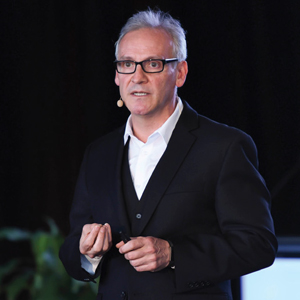
Rocky Scopelliti
’ of our digital society, culture, economies and the technologies that are intertwined in the way we live, work and play.
In 2017, trust in four key institutions – business, government, NGOs and media – has declined and hit a global crisis point. The 2017 Edelman Trust Barometer across 28 countries found that the majority of the 33,000+ respondents (53 per cent) now don’t believe the system is working for them, is unfair, and offers little hope for the future. Only 15 per cent believe it is working, with the rest uncertain. Without trust, belief in the system fails. People’s societal and economic concerns, globalisation, the pace of innovation and eroding social values are creating fears across the world.
When it comes to the impact that this erosion of trust has had on our digital lives, all the signposts point to the same direction – crisis. Whether it is cyber-attacks or economic loss, all the indicators lead us to the same conclusion. That is, like the Edelman study reflects, our digital lives are also at the same inflection point.
The impact of these ever increasing reports of widespread data breaches on people across all aspects of their lives, and their digital lives, serve to further erode the trust in the institutions that are the custodians of their personal information.
What impact does this have on reputation?
So, in the past garnering your trust to recommend became the Net Promoter Score (NPS) logic to support the measures claims of its predictive capacity. However, technology platforms have extended our circle of trust globally to much broader networks, beyond friend and family, to now include strangers or ‘likes’ and reviews. People we don’t know, yet we rely on their independent reviews, or ratings to make decisions.
 We make these decisions routinely such as reviews on travel destinations, accommodation on Airbnb, Uber rides, news, goods and services. What other people think about a product, service, organisation or person is based on past experiences that have accumulated over time or the reputation of the individual giving the review, which forms a measure of trustworthiness.
 These platforms make both sides of the transaction accountable, but not infallible. Reputation therefore is what Botsman describes as ‘trust’s closet sibling’.
But technology and machines also require trust and reputation particularly in light of the tsunami of sensors, objects, devices, robotic and autonomous vehicles now in development and use. How would you feel skiing down a slope when you’re overtaken by a robot on skis – what if they pushed in to the lift queue? What are the protocols? How do you address the intrusive machine? How do you look to other humans or robots in the queue?
Our relationship with technology is asynchronous. Our trust in technology is primarily centred on its functionality and the reputation of the manufacturer. But this is now changing. Our relationship with emerging technologies is becoming synchronous; our trust is shifting from trusting the technology and the reputation of the manufacturer to perform a task, to one that makes decisions and carries them out. These are decisions that put our lives in the hands of a software program of technology that thinks and learns. It becomes artificially intelligent.
How do we go about trusting technology?
This is the very question many of us are asking today with technologies such as artificial intelligence permeating many more aspects of our lives. For example, we ask Chatbots daily for information or to book taxis. We need to ask the question how do we go about trusting technology? After all, without trust, we simply won’t use it right.
Botsman’s research suggests that part of the answer can be explained with anthropomorphism – where the technology has human like tendencies and qualities, emotions and appearances. Studies have identified that self-driving vehicles that include anthropomorphic features via voice interactivity increased trial participants’ trust in the driverless vehicle. Early speech recognition systems and the first generation of interactive technologies blurred the boundaries between human and non-human. Researchers believe that we have a tendency to anthropomorphise technology because we are more likely to trust things that look, and sound like us.
A new approach to distributing trust
Distributed trust is defined as trust that flows laterally between individuals, enabled by networks, platforms and systems. Distributed trust is underpinned by the principle of ‘decentralisation’ where authority is transferred to uses away from central authorities such as governments, institutions, banks, or business. In the context of trust, it disperses functions, powers, people or things away from requiring an intermediary to confirm trust, where the network of computers confirms trust through a shared ledger recorded on a blockchain. The record is mathematically proven and hence immutable.
As a trust technology, blockchain has features that provide real-time validation, non-repudiation, configuration verification, transfer of risk etc. For example:
• Validation of transaction chains, such as Bitcoin
• Settlements for international financial payments, or share trading
• Data flows as with smart contracts
• Chain of custody, which has important applications in the agricultural, pharmaceutical where preparations can be tracked from providence to end user through supply chain mapping.
Blockchain has also been referred to as the ‘internet of value’, as the technology is a very significant transformative overlay on the internet that disaggregates, disintermediates and dematerialises value chains across many industries. Futurist Marc Andreessen has called it the most important technology since the internet itself.
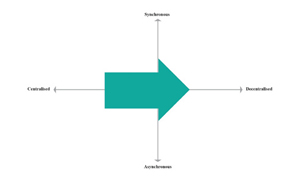
Let’s now bring these points together. In order to adapt trust to accommodate our digital lives, and its coverage to include additional actors, operating in a decentralised and real-time way, requires extending the topology from a centralised hierarchical position, into a decentralised position. I call this interconnected trust (see Figure 1) where actors or assets can be commissioned to perform the trust element within the synchronicity desired by the activity.
As so well articulated by Joseph Stiglitz: ‘It is trust, more than money, that makes the world go around’. Trust, is it the most important enabler for all that the 4th Industrial Revolution has to offer. It can not be an after-thought, but rather by design.
But technology and machines also require trust and reputation particularly in light of the tsunami of sensors, objects, devices, robotic and autonomous vehicles now in development and use. How would you feel skiing down a slope when you’re overtaken by a robot on skis – what if they pushed in to the lift queue? What are the protocols? How do you address the intrusive machine? How do you look to other humans or robots in the queue?
Our relationship with technology is asynchronous. Our trust in technology is primarily centred on its functionality and the reputation of the manufacturer. But this is now changing. Our relationship with emerging technologies is becoming synchronous; our trust is shifting from trusting the technology and the reputation of the manufacturer to perform a task, to one that makes decisions and carries them out. These are decisions that put our lives in the hands of a software program of technology that thinks and learns. It becomes artificially intelligent.
How do we go about trusting technology?
This is the very question many of us are asking today with technologies such as artificial intelligence permeating many more aspects of our lives. For example, we ask Chatbots daily for information or to book taxis. We need to ask the question how do we go about trusting technology? After all, without trust, we simply won’t use it right.
Botsman’s research suggests that part of the answer can be explained with anthropomorphism – where the technology has human like tendencies and qualities, emotions and appearances. Studies have identified that self-driving vehicles that include anthropomorphic features via voice interactivity increased trial participants’ trust in the driverless vehicle. Early speech recognition systems and the first generation of interactive technologies blurred the boundaries between human and non-human. Researchers believe that we have a tendency to anthropomorphise technology because we are more likely to trust things that look, and sound like us.
A new approach to distributing trust
Distributed trust is defined as trust that flows laterally between individuals, enabled by networks, platforms and systems. Distributed trust is underpinned by the principle of ‘decentralisation’ where authority is transferred to uses away from central authorities such as governments, institutions, banks, or business. In the context of trust, it disperses functions, powers, people or things away from requiring an intermediary to confirm trust, where the network of computers confirms trust through a shared ledger recorded on a blockchain. The record is mathematically proven and hence immutable.
As a trust technology, blockchain has features that provide real-time validation, non-repudiation, configuration verification, transfer of risk etc. For example:
• Validation of transaction chains, such as Bitcoin
• Settlements for international financial payments, or share trading
• Data flows as with smart contracts
• Chain of custody, which has important applications in the agricultural, pharmaceutical where preparations can be tracked from providence to end user through supply chain mapping.
Blockchain has also been referred to as the ‘internet of value’, as the technology is a very significant transformative overlay on the internet that disaggregates, disintermediates and dematerialises value chains across many industries. Futurist Marc Andreessen has called it the most important technology since the internet itself.
Let’s now bring these points together. In order to adapt trust to accommodate our digital lives, and its coverage to include additional actors, operating in a decentralised and real-time way, requires extending the topology from a centralised hierarchical position, into a decentralised position. I call this interconnected trust (see Figure 1) where actors or assets can be commissioned to perform the trust element within the synchronicity desired by the activity.
As so well articulated by Joseph Stiglitz: ‘It is trust, more than money, that makes the world go around’. Trust, is it the most important enabler for all that the 4th Industrial Revolution has to offer. It can not be an after-thought, but rather by design.
The articles from these contributors are based on their personal expertise and viewpoints, and do not necessarily reflect the opinions of their employers or affiliated organizations.
